
Knowing when to repair or replace an air conditioner isn’t always easy. While a quick repair may get your unit up and running again, the cost of frequent service calls can add up. Your old unit may be quietly costing you more by wasting energy, too.
This guide will walk you through the process of deciding when to replace an air conditioner and what to expect. This knowledge can help to take the stress out of the situation and assist you in making confident decisions.
5 Steps to Help You Decide Between Repairing or Replacing Your Air Conditioner
Deciding if you should repair or replace an air conditioner shouldn’t depend on guesswork. If you follow the right steps, you’ll have a solid framework for thinking through your situation and your options. Before you spend more money on repairs or a new system, there are several things you should consider.
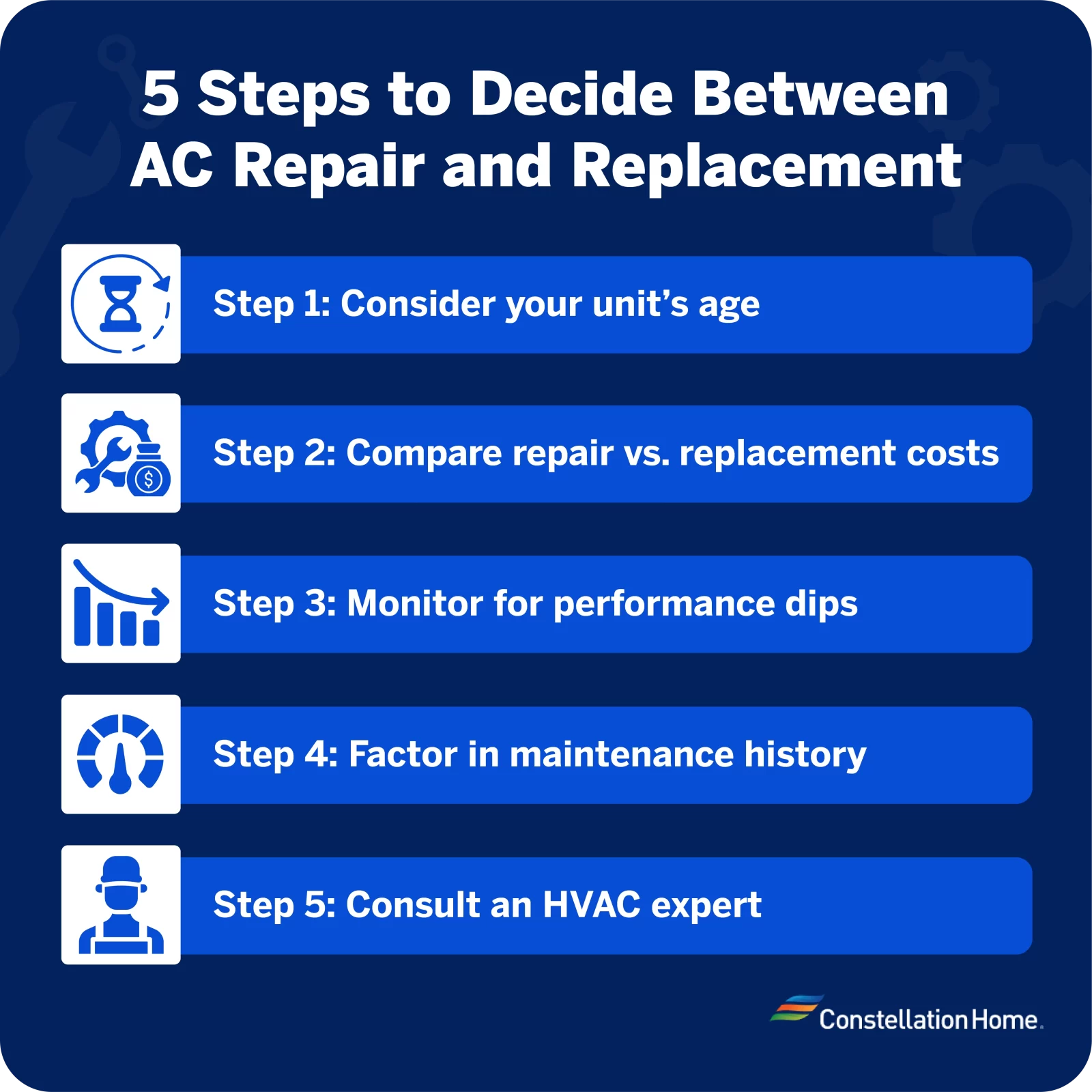
Step 1: Check the Age of Your Air Conditioner
The average lifespan of an air conditioner is between 10 and 15 years. If you’re starting to have trouble with your unit as it approaches these milestones, you may experience more regular breakdowns, downtime and service calls. Keep an eye and an ear out for warning signs that you need an air conditioner repair, and consider replacing your unit if it’s old or outdated.
Step 2: Compare Repair Cost vs. Replacement Cost
You may have heard about the “$5,000 rule” when considering replacing an air conditioner. Simply multiply the age of your unit in years by the estimated cost of the repair, and if the result is over $5,000, it may be smarter to replace your unit.
Before making a decision, consider if this is a one-time repair or if you’re experiencing repeated malfunctions. A single low-cost repair of an old unit that has been well-maintained can make sense. It can be helpful to talk to a professional to get their opinion about how much life is left in your unit.
Step 3: Look for Signs of Declining Performance
If your unit is experiencing performance issues, you may be paying the hidden costs of an inefficient system. It may be wasting energy and driving up your bills. Even after a repair, the inefficiencies may remain.
When deciding whether to repair or replace an air conditioner, these indicators may suggest that your unit is reaching the end of its lifespan:
- Warm air blowing when set to cool
- Excess humidity indoors
- Loud or unusual noises
- Bad odors when running
- Uneven cooling with weak airflow
- Frequent on-off cycles at short intervals
Step 4: Factor in Maintenance History and Long-Term Efficiency
If you make the effort to maintain your air conditioner, you can expect it to last longer and operate more efficiently. Without regular maintenance, your unit may be less likely to reach its expected lifespan. Look at its maintenance history when considering if a repair is reasonable or if you’ll get better value by replacing a worn-out unit.
Step 5: Get a Professional Opinion
If you still have doubts after carefully considering the issues above, it makes sense to talk to an HVAC professional. They can run diagnostics, evaluate the efficiency of your system and estimate how much remaining life your system has left. Getting a thorough assessment from an expert is a great way to make a truly informed decision.
When in Doubt, Talk to a Constellation Home Professional
There’s a lot to consider when deciding between repairing and replacing your air conditioner. Calling the experts at Constellation Home can take the guesswork out of your decision. A highly trained technician can evaluate your system and recommend the options that suit you. If you’re unsure about what choice to make, personalized guidance from our HVAC specialists can help you decide with confidence.
Frequently Asked Questions About Repairing vs. Replacing an Air Conditioner
How urgent is it to replace an older air conditioner that’s still working?
You might not feel the need to immediately replace your old air conditioner if it’s still working fine. As your unit ages, however, the risk increases that it will unexpectedly fail. Older units are also less energy efficient, which can be quietly costing you on your energy bills.
If your unit is at or near the 10- to 15-year mark, plan ahead to replace it so that you don’t have to make a rushed decision or deal with an emergency breakdown.
Can delaying the replacement of my air conditioner end up costing me more?
You may be tempted to delay the expense of replacing your air conditioner, but that may end up costing you more in the long run. Old systems tend to waste energy and drive up your energy costs. They’re more prone to breakdowns and expensive repair bills, which may end up costing you more than a new, energy-efficient system.
Does replacing my air-conditioning system add value to my home?
A new air-conditioning system can add value to your home, as it helps to ensure comfort and promotes energy efficiency. If you’re thinking of selling, a new system shows you’ve invested in maintaining your home and may make it more attractive to buyers.
Are there any rebates or incentives for replacing my air conditioner?
Rebates, tax credits, utility incentives and other programs may help offset the cost of buying a new and energy-efficient air conditioner. Incentives vary by location and the type of system you’re considering. You can start by checking the ENERGY STAR®️ Rebate Finder, as well as asking your local utility or HVAC professional.
